
DER Control Requires Co-Control
Proper grid control macrostructure promotes DER innovation.

There are lots of ideas around for completely changing the control structure and/or market structure of present day power grids, mostly in response to use of Variable Energy Resources (VERs), especially Distributed Energy Resources (DERs).1 Imagining entirely new power systems is a fun exercise - I know because I have done it, too. But let’s face it, the reality is that we are not going to rip and replace existing power systems with something radically different any time soon.2 What will work is a transition approach to an S2 grid that deals with DER integration issues while making the minimum necessary changes to the existing bulk system market-control structure and processes in the near term.
Rest assured that significant innovation will still be necessary. We can apply architectural “constraints that deconstrain” to help focus innovations on where they will actually be used. Here we will look at one of them: grid control macrostructure.
Grid Control Signal Types
Let’s think about power grid control being partitioned into two parts:
control of dispatchable resources
co-control of curtailable resources
I’ll explain the term co-control in a minute. For now, understand that this is not a decomposition into bulk system and distribution level control. That decomposition is important but will come later. For now, we are partitioning the controls based on whether the resources can be dispatched or only curtailed. Those that can only be curtailed include wind, solar PV, and load turndown (usually called demand response or DR). By including bulk energy storage in the dispatchable group, we can see three basic control signal (device setpoint) types (Fig. 1):
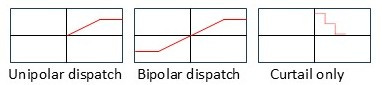
Unipolar dispatch applies to traditional generators, which can provide power output from zero to some max. Bipolar dispatch applies to storage devices, which can either output or absorb power. Curtailment control can apply to individual devices in either binary or continuous form. When applied to a group of resources its granularity can depend on both the number of devices under control and the degree to which the devices are cluster-coupled (cluster coupling reduces curtailment control granularity). For rooftop solar PV, curtailment may be applied to grid injection only or to grid and internal (behind the meter) use. The reason for curtailment of internal use of solar PV in existing power systems has to do with the bulk power system instability problem that can arise when bulk system apparent demand drops below a threshold value.
Control and Co-control
Compared to dispatch control, curtailment control feels a bit inverted.3 Its use for demand response goes back many decades but automated use for active resources with rapid dynamics (wind and solar) is relatively new. The reason for calling curtailment “co-control” is because curtailment of power injection is in a sense the complement of dispatch-based power injection.4
Control engineering contains a body of knowledge about systems in which the control can only pre-empt some function or operation. This is a form of supervisory control and is mostly applied to discrete event systems. Here we are pre-empting power injection by VER (wind and solar PV) and also possibly pre-empting power usage by storage or responsive loads (DR). These actions are complementary to increasing power injection by dispatchable resources, so, grid co-control is supervisory pre-emptive control for VER/DER.
Control Structures
Keeping in mind our objective of preserving in the near term as much as we can of standard bulk power system demand-tracking balance regulator control, let’s look at some structures. First, a simple form (which I hope nobody actually uses) that illustrates a structural problem to be avoided (Fig. 2).
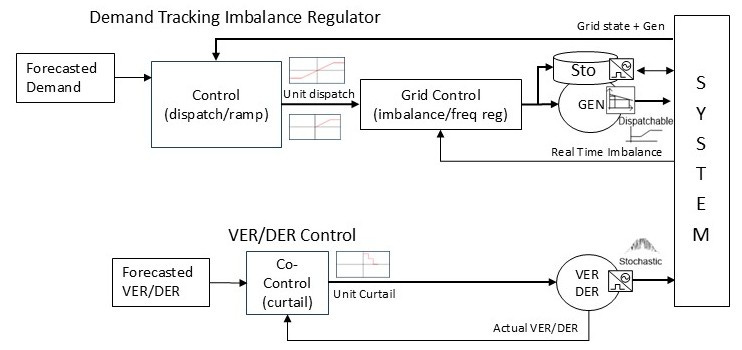
We can immediately see that this control structure has a hidden coupling problem, known as indirect dependency in control engineering. Two issues: since the controls are uncoordinated, the balance regulator reacts to VER as a perturbation, and volatility created by the VER is injected into the real time imbalance control loop.5
We might address these problems by making the curtailment co-control subordinate to the dispatch control (Fig. 3).
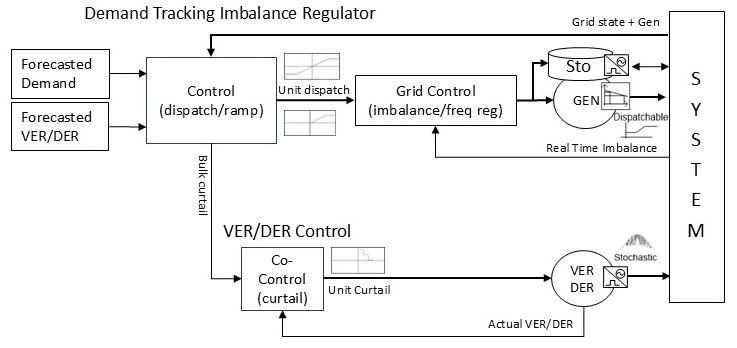
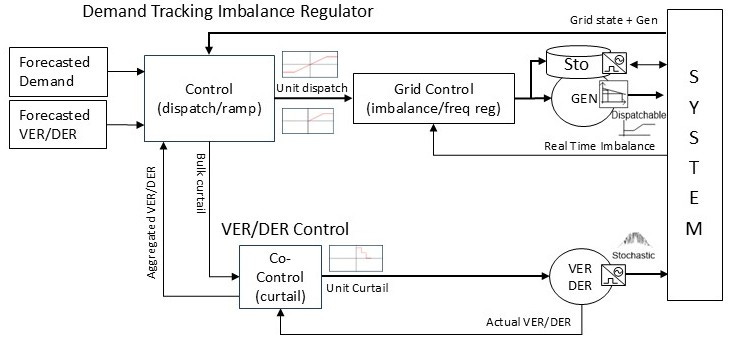
The co-control is subordinated to the dispatch control instead of the other way around so that we can preserve as much as possible of the existing grid control system. The co-control must break down the bulk curtailment command from the dispatch control into unit curtailment commands in the same way that Area Control Error is broken down into unit control errors for frequency regulation in bulk power systems. Because VER/DER owners do not like curtailment, this raises a question about fairness - more on this shortly.
The arrangement of Figure 3 enables some coordination of control and co-control, but the control still has no direct means to deal with real time VER/DER behavior and VER/DER volatility is still injected into the real time imbalance control loop.
The arrangement of Figure 4 addresses this by moving the actual VER/DER feedback from the co-control to the dispatch control level.
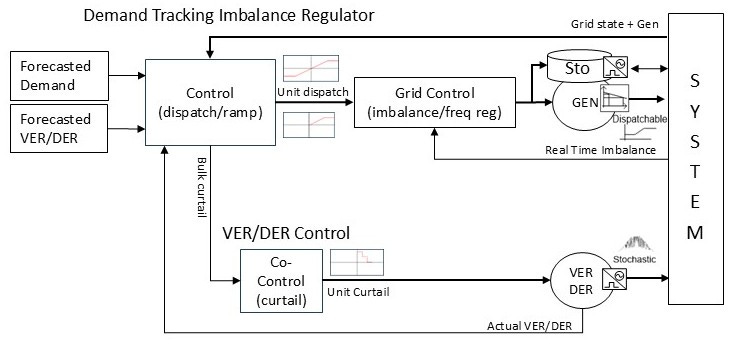
This form enables stronger real time coordination than the previous forms, but looking forward a bit, we can see that it will result in a telemetry scaling issue for the dispatch control, especially in the case of large scale DER penetration.
To deal with this, the interface between the control and co-control can be structured as a bidirectional interaction instead of a straight hierarchical command. This arrangement (see Fig. 5) still enables coordination but in a form that can be translated into a distributed Laminar form via layered decomposition that can make use of multiscalar analytics and entropy reduction.
The interaction can be an iteration or can be in the form of a negotiation; either would be consonant with DSO models.
Curtailment and Fairness
If curtailment is granular, then the issue of fairness in curtailment arises. While there are some simplistic brute force methods, any curtailment approach that seeks to serve some customer-oriented objective raises the spectre of optimization. This problem has arisen and been dealt with in other fields, notably wireless communication, where it concerns dynamic allocation of cell tower bandwidth, for example. Known solutions can address a variety of optimization objectives.
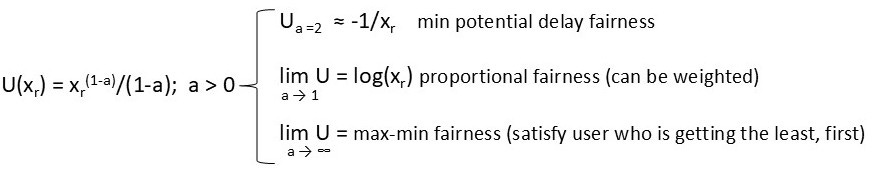
Let’s look at some math. Here xr is the rth element of a set of elements over which we wish to optimize some objective. So xr might be the injection permission (the dual of curtailment) allocated to the rth curtailment resource. This can accommodate both injection and withdrawal limits for flexible connections.
One way to formulate the optimization problem is with the utility function U in Figure 6. By adjusting the parameter a, it is possible to select from several approaches to fairness.
The literature on network utility maximization through layered decomposition contains many approaches to solving similar problems. If you are up for some full contact mathematics, try these:


Takeaways
Some guiding principles:
Partition grid control into two parts: control (for dispatchables) and co-control (for non-dispatchables); minimize changes to the bulk power system control structure and processes for now,
Connect control and co-control via an iteration/negotiation interface (see Fig. 5),
Recognize three grid control/co-control signal types (see Fig. 1),
Beware of cluster coupling and scaling issues related to DER/CER,
Recognize that any but the simplest curtailment approaches will involve some form of real time fairness optimization; adaptable solutions exist in the telecommunications industry.
Given the above, there are still massive opportunities for innovation: DER/CER integration, management, coordination, and control; use of the system triangle in structuring distribution level control including inverter control, Transmission/Distribution Coordination, DSO integration and functions, aggregator/VPP integration, distribution level visibility and observability, emergency backstop, black start support, curtailment fairness, distribution and DER/CER communications, scalable distribution/DER telemetry, energy storage integration and control, resilience, cyber-physical security…
LOTS of room for innovation.
Final Comment
A well-planned grid architecture simplifies downstream decisions and frees up innovators, engineers, and developers working on individual components or systems to employ their creativity with assurance that unintended consequences will not crop up to hamper or even invalidate their work. Grid Architecture is actually the innovator’s best friend.
Also known as Grid Edge Resources (GERs) or Consumer Energy Resources (CERs) if behind the meter.
Remember - their job is to keep the lights on. It can be a matter of life and death.
If we change curtailment into “injection permission” or “withdrawal permission” we can flip the control signal.
I borrowed the idea for this terminology from a concept in magnetics. In magnetics, co-energy is the dual of energy, so that the two are essentially complementary. I have adapted (bent?) this concept to describe the two complementary controls in a system with both dispatchable and non-dispatchable resources.
Properly used bulk energy storage could mitigate the volatility problem. There is a general approach to use of storage as grid shock absorbers to manage volatility propagation. We should use it.